Guide · Mixing
How to Fix Frequency Masking
Put a kick and a bass together and they occupy the same few hertz. Put a guitar and a vocal in the same octave and the same thing happens. The result is not mud exactly. It is something worse: the listener hears one instrument where there are two, and cannot work out why the mix feels thin.
What Masking Is
Masking happens when two sounds occupy the same frequency range at the same time. The ear cannot process both usefully, so one of them masks the other. The masked part is not quiet; it is unintelligible. You can turn it up and it will simply get louder and still not be heard properly.
This is why the cure is not usually volume. Raising the level of a masked part does not separate it from the part that is masking it, it just makes both of them louder. The frequencies have to be separated.
The Classic Case: Kick and Bass
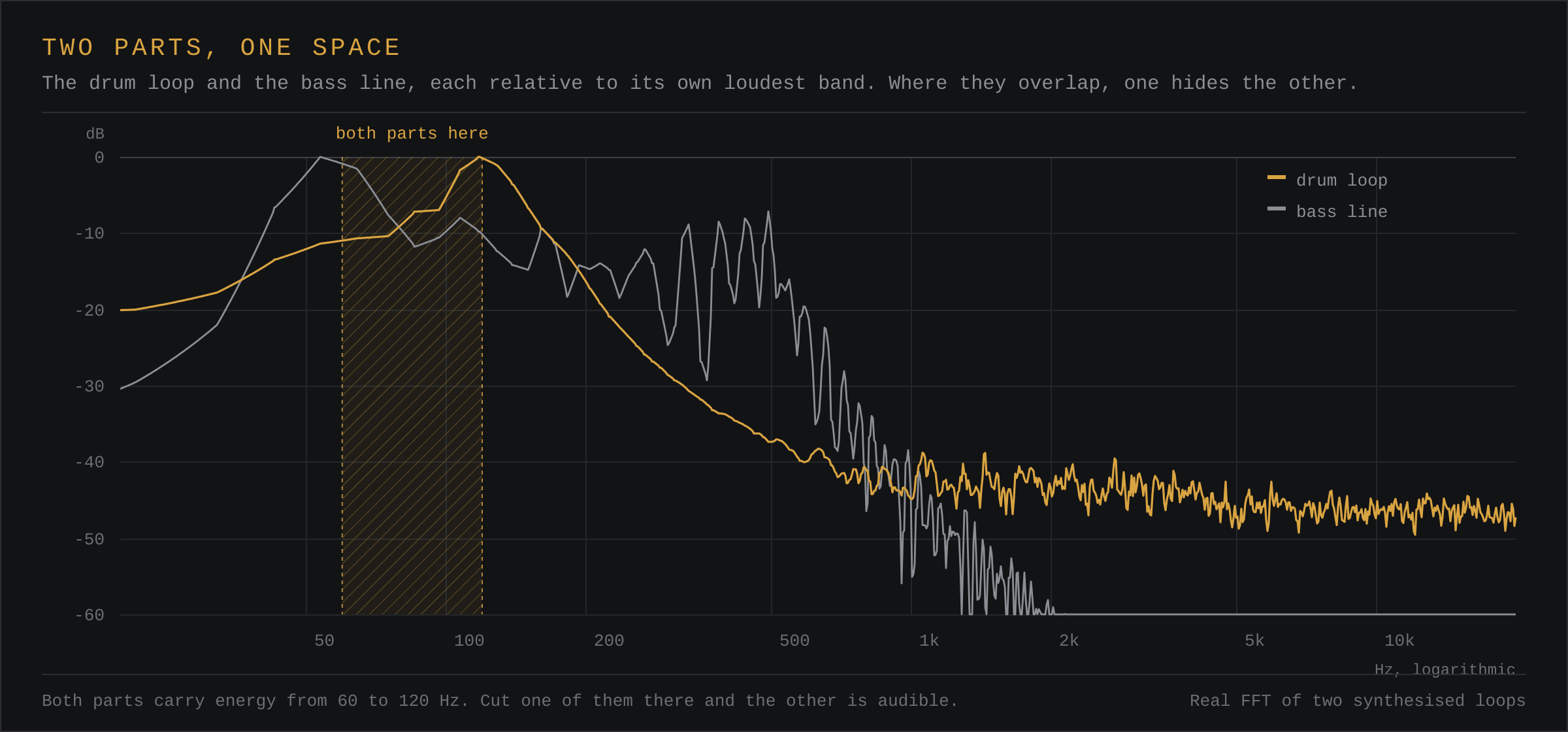
A kick drum with a fundamental around 50 to 60 Hz and a bass playing the same note are fighting over roughly the same third of an octave. This is the most common masking problem in popular music, and it is the one most people first learn to fix.
There are three ways to solve it, in order of how much they cost you.
- High-pass the bass. Cut everything below 80 to 100 Hz and the bass moves above the kick. The bass keeps its note, because a bass guitar's fundamental at 55 Hz is audible, but the very bottom is gone and the kick has room. This is the usual answer.
- Change the arrangement. If the bass does not need to play the root at the same time as the kick, it does not need to be solved in the mix. A bass part that moves away from the root, or a kick that plays on different beats, removes the conflict completely.
- Time-share them. Sidechain compression ducks the kick every time the bass plays. This is the pumping effect, and it is a legitimate answer, though it is a stylistic one.
In practice most mixes use the first, sometimes with a bit of the second. The third is reserved for genres where it is a signature.
How to Find It
The masking finder on this site does this in one step: load two files, and it compares them band by band, marks the region where they compete, and tells you which part to cut. It is the fastest way to see the conflict.
You can also do it by ear, and it is worth learning to. The sign of masking is not a bad sound, it is a missing sound. If you mute the bass and the mix does not feel emptier, the bass was masked and nobody was hearing it anyway. If you mute the kick and the mix barely changes, the kick was hidden. That test takes five seconds and settles the argument immediately.
The other ear test is to listen to each part solo, then together, and notice which one disappears.
Which Part to Cut
The general rule is to cut the part that is being hidden, not the part doing the hiding. This is counter-intuitive, because the louder part feels more important.
The reason is that cutting the louder part changes the balance of the mix. If the kick owns 40 to 120 Hz and you cut 4 dB there, every other part in that range comes up in proportion. It fixes the bass and breaks the mix. Cutting the bass, which is the part losing the fight, changes the balance of the mix in the direction you want anyway.
The exception is when the part doing the hiding is the one that is wrong. If the kick is fundamentally too low for the arrangement, cut the kick. But that is an arrangement decision dressed up as a mixing one, and it is rarer than it sounds.
How to Cut
Use a narrow bell filter rather than a shelf. You want to affect the contested region and nothing else.
- Broad tonal build-up, like a low midrange that has accumulated across several parts: a Q of 1 to 2, and 2 to 4 dB. The cut should be gentle enough that you cannot hear it on the part in isolation.
- A specific conflict, like a bass note at 55 Hz against a kick at 50 Hz: a Q of 3 or higher, and 3 to 6 dB. Narrow enough to leave the rest of the bass intact.
- A moving conflict, where the bass plays different notes: cut the fundamental of the kick rather than trying to carve every note.
A helpful rule for judging the size of a cut: if you can hear the EQ change on the part by itself, it is too much. If it only makes sense in the context of the full mix, it is about right.
What Does Not Work
Turning one part up. As established, this makes both parts louder and neither clearer. If you have tried it and the mix did not improve, the problem is not level.
High-passing both parts. This is the classic beginner's move and it destroys both instruments. The kick loses its fundamental and becomes a click, and the bass becomes thin and undefined. Filter one, or neither.
Panning them apart. Stereo position does not change frequency. Two instruments at the same frequency in different places still mask each other, and a mono listener hears them collide even harder.
Compressing one of them harder. Compression narrows dynamics, it does not separate frequencies. It can make a masked part slightly more present, but it will not make it intelligible.
When It Is Not Masking
Sometimes two parts sound like one because they are arranged that way, and no amount of EQ will help. If a guitar doubles a vocal melody exactly, they are one sound and should be treated as one.
It can also sound like one because one is simply too quiet to be heard, which is a level problem rather than a frequency one. The mute test distinguishes these quickly.
Questions
What is frequency masking?
It is when two parts occupy the same frequency range at the same time. The ear processes one of them usefully and the other becomes inaudible or indistinct, so the mix sounds like one instrument where there are two.
Should I EQ the louder or the quieter part?
Usually the quieter part, because it is the one being hidden. Cutting the louder part changes the balance of the mix and affects everything else sharing that range, which is usually a worse trade.
How wide should the EQ cut be?
Narrow enough to leave the rest of the part alone. A Q of 1 to 2 is right for a broad tonal problem like a low midrange build-up. A Q of 3 or higher is right for a resonance or a single note fighting a single note.
Can masking be fixed with level alone?
Sometimes, and it is always worth trying first because it costs nothing. If one part is simply louder, riding its fader down can reveal the other. But if both are at sensible levels and one is still hidden, the problem is the frequency, not the volume.