Guide · Equalisation
How to EQ a Kick Drum
The kick is the part of a mix that most often gets EQ-ed badly, usually because it is treated as a lump of low end rather than as a note with a fundamental, a body and a click. Here is a method that works on almost any kick.
Step One: Know What You Are Working With
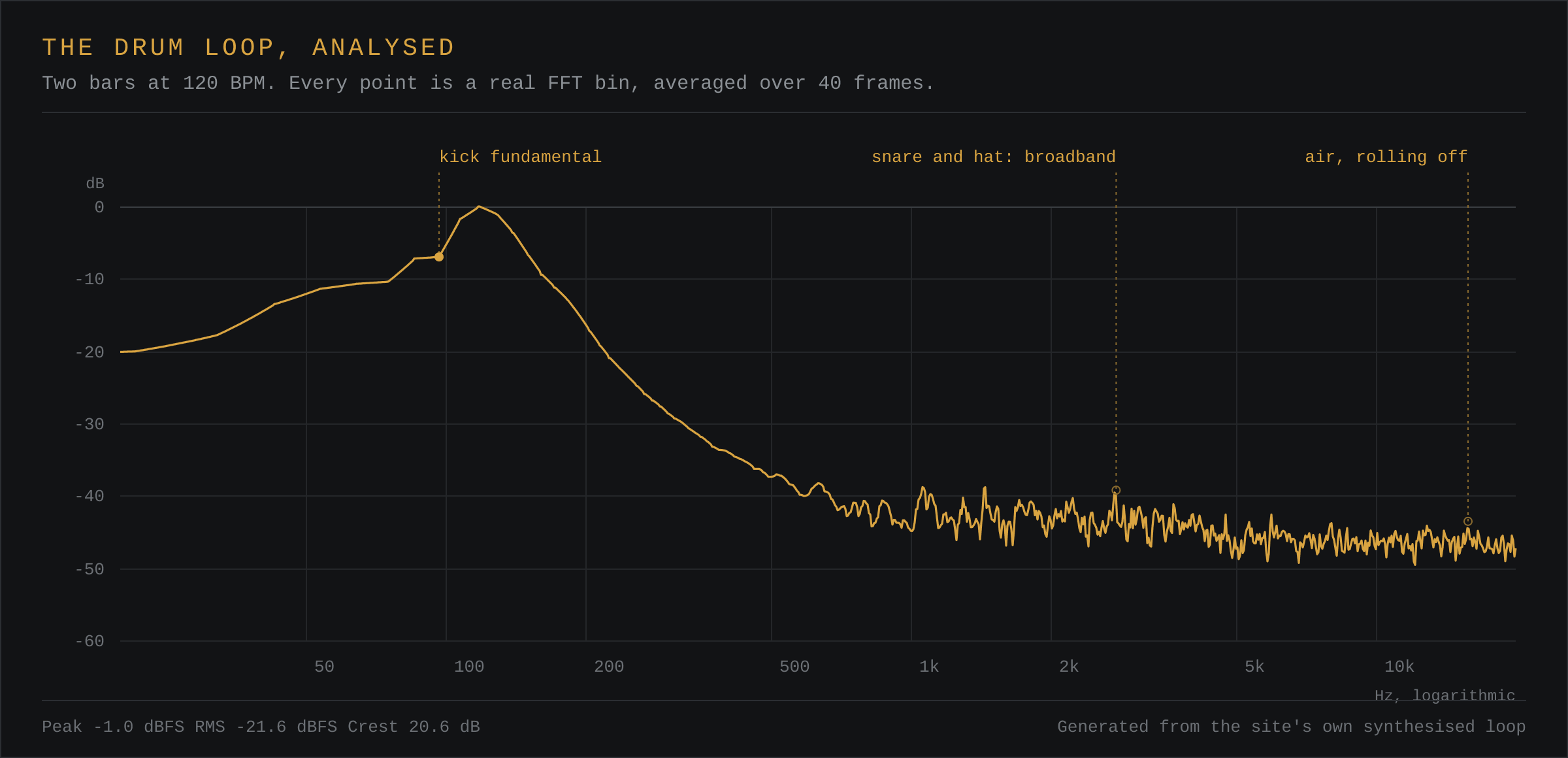
Before touching a filter, you need to know three things about the kick: where its fundamental is, what its resonant character is, and how it sits against everything else. The analyser answers the first two. Solo the kick, load it, and look at the spectrum.
You are looking for three things. A fundamental: the lowest frequency with real energy, usually the tallest peak. A body: the broad spread of energy from about 60 Hz to 300 Hz that gives the kick its weight. And resonances: narrow, spiky peaks that sit on top of everything else, usually between 300 Hz and 1 kHz, which are the shell and the drum body ringing.
What you do not want is to guess. "Kick EQ" is not a setting. A 50 Hz kick and an 80 Hz kick need different decisions, and only the analyser will tell you which one you have.
Step Two: The High-Pass
The first filter is a high-pass, and it is not an EQ move so much as a clean-up. Set it below the fundamental: 30 to 40 Hz for a kick tuned around 50 to 60 Hz. The slope should be steep enough to remove subsonic energy, so 12 or 24 dB per octave.
Subsonic content below 30 Hz does two things, both bad. It is inaudible on most systems, so it takes up no useful space. And it moves your mix bus meters, so it makes you turn everything down and then wonder why the kick feels weak.
The full reasoning is in the guide to high-pass filters.
Step Three: Decide About the Fundamental
This is the decision most people get wrong, so it is worth being blunt about it.
A kick usually needs a small cut, not a boost. A tuned kick has a definite pitch, and in a mix that pitch is competing with the bass. A cut of 1 or 2 dB at the fundamental, with a wide Q so it affects only the kick, buys the space without making the kick disappear.
Boosting the low end of a kick is the reflex move, and it usually makes things worse. You are adding weight to a part that already has weight, and the bass line, which is the thing that actually needs to be heard, gets pushed further down.
There are exceptions. A kick recorded in isolation, on its own bus, with a bass that has been carefully carved to sit above it, can be boosted. But that is a later decision made against a finished arrangement, not a starting point.
Step Four: Cut the Resonances
Narrow peaks between 300 Hz and 1 kHz are the shell ringing. They are what makes a kick sound boxy, hollow or "thumpy" rather than solid, and they take up the same space as the lower midrange of a guitar or a vocal.
Cut them with a narrow band: 2 to 4 dB, with a Q between 3 and 6. High Q means you affect a narrow slice of the spectrum and leave the rest alone. A gentle cut will not remove a resonance, and a broad cut will take the punch with it.
Two or three of these cuts is normal. A kick with a resonant 400 Hz peak and another at 750 Hz needs both treated. Do them one at a time, and bypass between each to hear what you have actually changed.
Step Five: The Click
The attack of a kick comes from a very short transient at the top of the spectrum, and it is the same energy that makes a 60 Hz kick cut through a mix on small speakers. It is also the first thing people want to remove, and it is the last thing they should.
If the click is a problem, it is usually because it is too bright relative to the rest of the kick. Two ways to deal with it:
- A narrow cut of 2 to 4 dB with a Q of 3 or more, between 3 and 6 kHz, aimed at the specific frequency where the click sits.
- A high-pass at around 8 kHz with a steep slope, which keeps the body and the fundamental and removes only the very top.
What you must not do is cut broadly across the top end. A scooped 6 to 10 kHz turns a punchy kick into a flabby one, and no amount of compression will bring the attack back.
Step Six: Compression, and Where It Sits
Once the kick is clean, compress it. A 3:1 or 4:1 ratio with a threshold that catches about half the hits is a reasonable starting point, with a fast attack so the transient survives and a release around 80 to 150 ms so the kick does not pump against the pattern.
Compress before you equalise and you will chase a moving target, because the compression changes the balance you are trying to correct. Equalise, then compress, then listen again with fresh ears.
The compressor has a live transfer curve and a gain-reduction meter, which is the fastest way to see whether the settings are doing what you think.
How to Know You Have Got It Right
- The fundamental is audible on small speakers. If the kick only appears on big ones, it is too low. A little more at 60 to 80 Hz fixes it, but a small cut on the bass is usually better.
- You can hear the note. A tuned kick should have a pitch you could hum. If it does not, the fundamental is buried or the tuning is fighting the arrangement.
- The bass and the kick do not sound like one instrument. If they fuse into a single thud, they are fighting. That is a masking problem, and it needs EQ on the bass or a different arrangement, not more kick.
- Nothing pumps. If the kick is ducking the rest of the kit unevenly, the release is too short or the threshold too high.
Common Mistakes
Cutting the fundamental because it is loud. Loud is not the same as wrong. If the kick is the right note and the right weight, it stays.
Boosting 5 to 10 dB because the kick feels small. If it feels small, the problem is usually somewhere else: too much low end elsewhere, no click for definition, or a mix that has been over-compressed.
Using one setting for every kick. Every kick is different. A 60 Hz tuned 808 and a 90 Hz beater-heavy acoustic kick need different corners, different cuts, and usually different compression. The method transfers; the numbers do not.
Questions
What frequency is a kick drum?
It depends on the instrument. A tuned kick has a fundamental somewhere between 40 and 80 Hz, and most of its weight sits below 120 Hz. An 808 sits around 50 Hz, a modern punchy kick around 55 Hz, and a beater-heavy acoustic kick can be much higher. Find it on your own kick rather than assuming.
Should I boost or cut the low end of a kick?
Usually cut, and usually gently. A high-pass filter handles the rumble below the fundamental, and a small cut of 1 or 2 dB at the fundamental is enough to make room for a bass. Boosting the low end of a kick that already sits with a bass usually just means both are too heavy.
How do I get rid of the click on a kick?
The click is usually a high-frequency transient from the beater or the stick. A narrow cut of 2 to 4 dB with a high Q between 3 and 6 kHz removes it, or a high-pass at around 8 kHz with a steep slope. Do not cut broadly, or the kick loses its attack.
What order should EQ and compression go in for a kick?
Cut before you compress. A compressor reacts to everything it is fed, so any rumble or click still in the signal will make it duck and pump for the wrong reasons. High-pass, cut the resonances, then compress.