Guide · dynamics
Crest Factor and How Much Compression Is Enough
Crest factor is the difference between a file's peak level and its average level. It is the cheapest way to tell how much of a recording's transient detail is still intact.
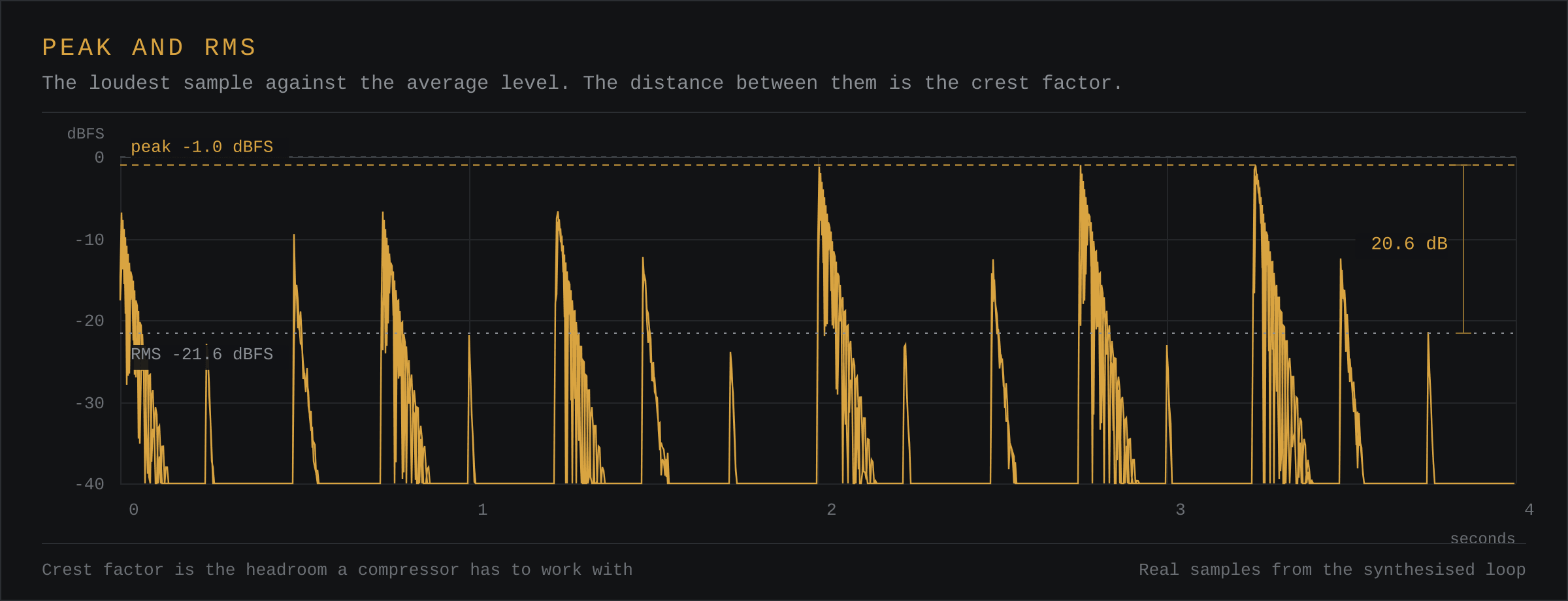
The Measurement
Peak level is the loudest single sample. RMS is the average power over time. Crest factor is the first minus the second, expressed in decibels. A file that peaks at −1 dBFS and has an RMS of −15 dBFS has a crest factor of 14 dB.
That number describes the gap between the hits and the body. A large gap means the transients stand well clear; a small gap means the material is dense and any further compression will flatten what is left.
Rough Bands
| Crest factor | Reading | Typical source |
|---|---|---|
| 18 dB + | Very dynamic | Unprocessed acoustic recording |
| 12–18 dB | Dynamic | Raw multitrack, light bus processing |
| 8–12 dB | Controlled | Mixed but not limited |
| Under 8 dB | Dense | Heavily compressed or limited |
These are guides, not targets. A dense genre can sit at 8 dB and sound right; a sparse acoustic piece at 12 dB can sound over-compressed.
Using It While You Work
Measure before you compress, then measure again after. If a compressor with a 4:1 ratio and a −20 dB threshold takes the crest factor from 15 dB to 11 dB, it is doing meaningful work. If it takes it to 7 dB, you have removed most of the transient information and will hear it as a loss of impact rather than an increase in punch.
The same logic applies to limiting. A limiter that reduces peak level without touching RMS will lower crest factor sharply. That is what limiting is for, but it is also why over-limiting sounds flat: the peaks that give a drum its attack are exactly what has been removed.
A Caveat
Crest factor is a whole-file statistic. It cannot tell you where the dynamics changed, and a single loud transient can dominate the peak reading. Treat it as a summary, and confirm with your ears and a gain-reduction meter.
It is also only meaningful against a reference. A crest factor of 12 dB is neither good nor bad on its own; what matters is whether it fell by 4 dB when you made a change. Measure the before and the after with the same tool on the same material, and the number becomes useful.
Crest Factor Against Loudness
Crest factor and loudness measure different things and move in opposite directions. Loudness says how loud the file will feel; crest factor says how much of the punch is still there. Two masters can measure the same integrated loudness and differ by several dB of crest factor, which is exactly why one will sound open and the other flat at matched level.
This is the practical argument against mastering to a loudness target alone. Hitting −14 LUFS by compressing hard and hitting −14 LUFS by leaving the peaks alone are different records. The crest factor is the number that records the difference.
Where the Reading Comes From
The peak is taken from the raw sample data at full resolution. The RMS is a mean over the whole file, not a per-frame figure. That distinction matters at the edges: a file that starts with silence and ends in a cymbal will report a crest factor dominated by the cymbal, because the RMS is dragged down by the silence but the peak is not.
If you want to compare two versions, therefore, trim them to the same start and end. Otherwise you are comparing the shape of the arrangement rather than the effect of the compression.
What Different Sources Usually Measure
| Source | Typical crest factor | Why |
|---|---|---|
| Drum bus | 14–20 dB | Short, loud transients against a comparatively quiet body |
| Bass guitar, DI | 10–14 dB | Sustained note with a distinct pluck |
| Lead vocal, close mic | 12–18 dB | Consonants are brief and much louder than vowels |
| Synth pad | 4–8 dB | Steady state, with almost no transient at all |
| Full mix, unlimited | 12–16 dB | The loudest single hit sets the peak for everything |
| Mastered, streaming target | 8–11 dB | Peaks controlled to reach a loudness figure |
The useful signal in this table is the spread, not the individual figures. A pad and a drum bus are not comparable, so there is no sense in which one is "better" than the other. What the numbers let you do is notice when a part sits far outside the range for its type: a bass at 20 dB is unprocessed, and a pad at 14 dB has something wrong with it, most likely a click or a gate artefact rather than musical dynamics.
Questions
What is a good crest factor?
There is no single target. Somewhere between 10 and 16 dB suits most mixed material, with sparse acoustic recordings higher and dense electronic productions lower. What matters is the change: a compression move that drops the number by 4 dB or more is doing a lot.
Does a higher crest factor mean better quality?
Not on its own. A high crest factor means the transients are intact, which is good for punch, but it also means the file has less average level for the same peaks. A very high figure on a finished master usually means the mix has not been controlled at all.
How is crest factor different from dynamic range?
Dynamic range normally describes the difference between the quietest and loudest passages of a performance over time. Crest factor describes the difference between peak and average within the file as a whole. A track with very little variation in level can still have a low crest factor, because everything is dense.
Why did my crest factor drop when I did not add compression?
A limiter, a clipper, or a saturator will all reduce it, even if the compressor is off. So will normalising a file whose peaks were already at the ceiling, because the gain cannot raise the peaks any further while it does raise the average.